For centuries, the relationship between an artist and their medium has been defined by patience.
If you work with oil on canvas, you are at the mercy of the atmosphere. You apply a base layer, and then you wait. You wait hours, sometimes days, for the pigment to cure and the surface to become workable again. In that silence between layers, the creative spark can sometimes flicker—or even fade. Traditional art, in many ways, is a marathon of endurance.
But what if creation didn’t have to wait?
The End of Friction
We are entering a new era, one where the medium responds almost instantly to intention.
With the rise of AI-assisted tools, digital painting systems, and generative models, the delay between idea and execution is shrinking. What once required days of layering, drying, and revision can now unfold in seconds.
A thought becomes a sketch.
A sketch becomes a composition.
A composition becomes a finished piece almost as quickly as the idea itself appears.
This is not just a technological shift. It is a fundamental change in the rhythm of creativity.
From Process to Flow
Traditional painting enforces a structured workflow:
- Plan
- Apply
- Wait
- Reflect
- Continue
Modern tools collapse this sequence into something far more fluid:
- Think
- See
- Adjust
- Iterate
The process becomes continuous, almost conversational. Instead of working through the medium, the artist begins working with it in real time.
In this new paradigm, creativity starts to resemble an iterative system, closer to optimization than execution. You are no longer committing to a single path; you are exploring a landscape of possibilities, refining toward something that feels right.
Speed vs. Depth
But this shift raises an important question:
When creation moves at the speed of thought, do we gain clarity or lose depth?
The waiting in traditional art is not just a limitation; it is also a space for reflection. It forces the artist to pause, to reconsider, to live with the work before continuing. Some of the most meaningful decisions in art happen in those quiet in-between moments.
When that space disappears, so does a certain kind of tension.
And yet, something new replaces it.
A New Kind of Discipline
Speed does not eliminate effort; it redistributes it.
Instead of waiting for paint to dry, the artist must now manage abundance:
- Endless variations
- Infinite undo/redo
- Rapid iteration loops
The challenge is no longer how to continue, but when to stop.
Precision becomes a mental discipline rather than a physical constraint. The artist must develop a sharper sense of intention because the medium will no longer slow them down.
The Hybrid Future
This is not a story of replacement. It is a story of expansion.
Traditional and modern methods are not enemies—they are complementary forces.
Imagine starting a painting by hand—feeling the texture, the resistance, the imperfections—and then using AI to explore color variations, compositional shifts, or entirely new directions. The final piece becomes a collaboration between human intuition and computational possibility.
The brush and the algorithm begin to speak the same language.
Art Without Waiting
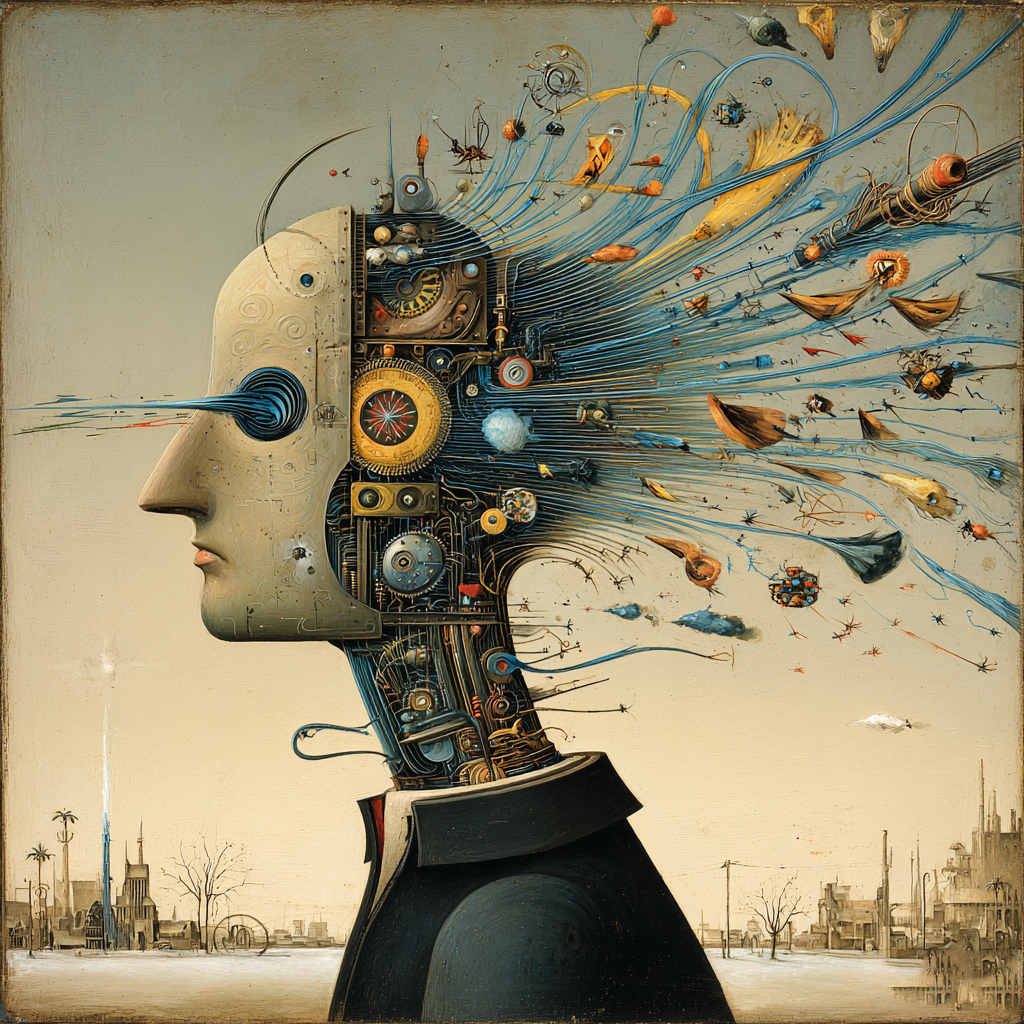
We are moving toward a world where creativity is no longer bound by physical delay.
The drying time is gone.
The friction is reduced.
The loop between imagination and realization is tighter than ever.
But the responsibility shifts to the artist.
Because when the medium no longer slows you down, the only limit left is how clearly you can think—and how honestly you can see.
Art at the speed of thought is not easier.
It is simply more revealing.